
Free Estimates on New Roof, Siding, Gutter Replacements


Free Estimates on New Roof, Siding, Gutter Replacements
(630) 520-0576
Mon - Sat: 8am to 8pm

What Type of Siding Is Best for Illinois Winters?
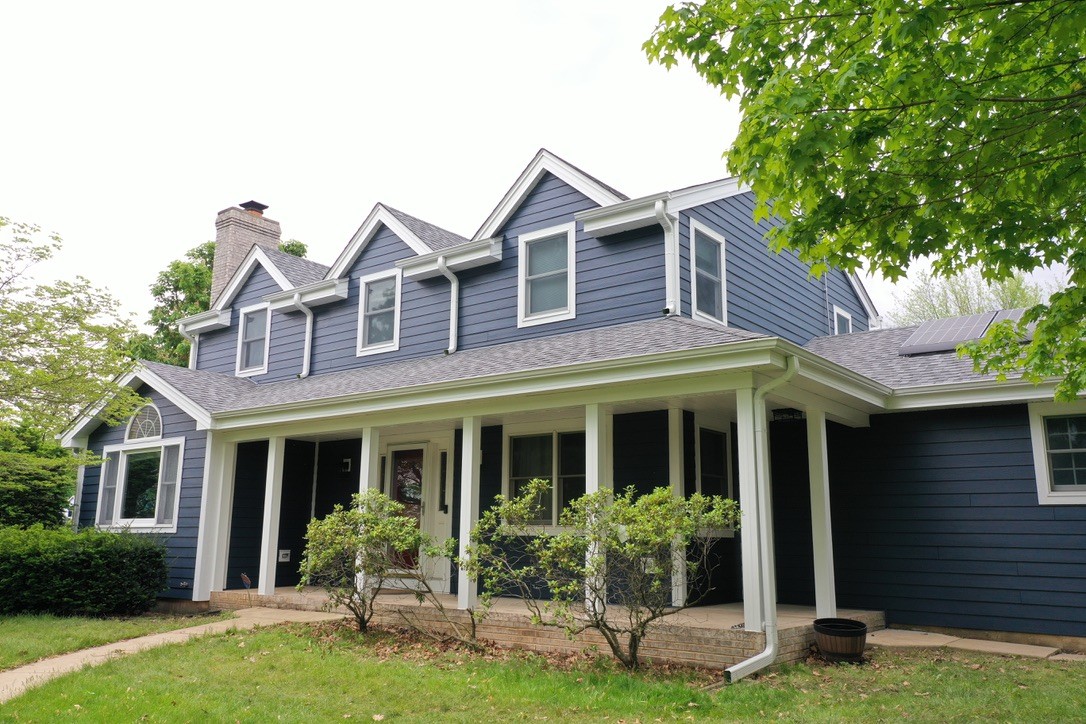








Choosing siding for winter in IL is about more than curb appeal. The right type of siding can help protect exterior walls from moisture, support the home’s thermal performance, and prepare the building envelope for snow, wind, and repeated freeze-thaw conditions.
For Illinois homeowners planning an exterior update, fall can be a practical time to replace worn or damaged siding before colder weather exposes existing weaknesses.
Why Fall Is a Smart Season for Siding Projects
Fall can provide practical conditions for siding work when temperatures, daylight, and weather remain within manufacturer installation requirements.
Scheduling before colder weather becomes less predictable also gives homeowners more flexibility if rain, wind, material deliveries, or unexpected exterior repairs affect the project timeline.
Moderate Temperatures Can Support Installation Quality
Extreme summer heat and deep winter cold can make exterior work more challenging. Moderate fall temperatures can provide more manageable conditions for handling and installing siding materials.
A siding project also involves more than the visible panels. Housewrap, flashing, trim, fasteners, sealants, insulation, and water-management details all need to be installed according to the requirements of the selected system.
New Siding Adds Protection Before Snow and Ice Arrive
Damaged siding can leave exterior walls more vulnerable to wind-driven moisture.
Cracks, loose panels, missing sections, deteriorated trim, or poorly sealed penetrations may allow water to reach the layers behind the siding.
Winter can make those weaknesses more difficult to address.
Replacing damaged siding in fall gives homeowners an opportunity to correct exterior problems before snow, freezing rain, and repeated temperature swings arrive.
Exterior Improvements Can Support Heating-Season Efficiency
Siding is only one part of a home’s energy performance, but replacement work can provide an opportunity to inspect the exterior wall assembly and address gaps in weather protection.
When appropriate, homeowners may also consider continuous exterior insulation to reduce heat transfer through wall framing. The actual benefit depends on existing insulation, air sealing, windows, doors, and the overall construction of the home.
What Type of Siding Performs Best in Illinois Winters?
The best type of siding for an Illinois home depends on moisture exposure, maintenance expectations, wall condition, and how the material handles seasonal temperature changes.
Fiber cement, engineered wood, and vinyl can all perform successfully in Illinois when the product is suited to the home and installed according to manufacturer requirements.
Fiber Cement and Freeze-Thaw Conditions
Fiber cement is a dense exterior cladding made from cement-based materials and reinforcing fibers. It is commonly selected for its durability and dimensional stability.
Winter performance still depends heavily on moisture management. Proper flashing, clearances, drainage details, and finishing help keep water from reaching vulnerable areas before repeated freezing and thawing occur.
Fiber cement should therefore be treated as part of a complete exterior wall system rather than as a standalone moisture barrier.
Engineered Wood Offers a Different Material Profile
Engineered wood siding uses wood strands or fibers combined with resins and protective treatments. Products such as LP SmartSide are designed to provide a wood-like appearance with engineered consistency and durability.
Engineered wood siding itself should not be confused with insulation. Any thermal-performance benefit depends on the complete wall assembly and whether additional insulation is installed behind the siding.
Its lighter weight compared with some fiber cement products may also affect handling and installation, depending on the project.
Vinyl Siding Requires Proper Cold-Weather Installation
Vinyl siding is widely used because it is relatively low maintenance and available in many colors and profiles.
It also expands and contracts as temperatures change.
Proper installation allows panels to move rather than fastening them so tightly that seasonal movement causes distortion.
During very cold weather, vinyl can become more brittle and may be more vulnerable to impact.
That does not mean vinyl siding cannot perform in Illinois. It means installation details, product quality, and correct fastening become especially important in a climate with significant seasonal temperature changes.
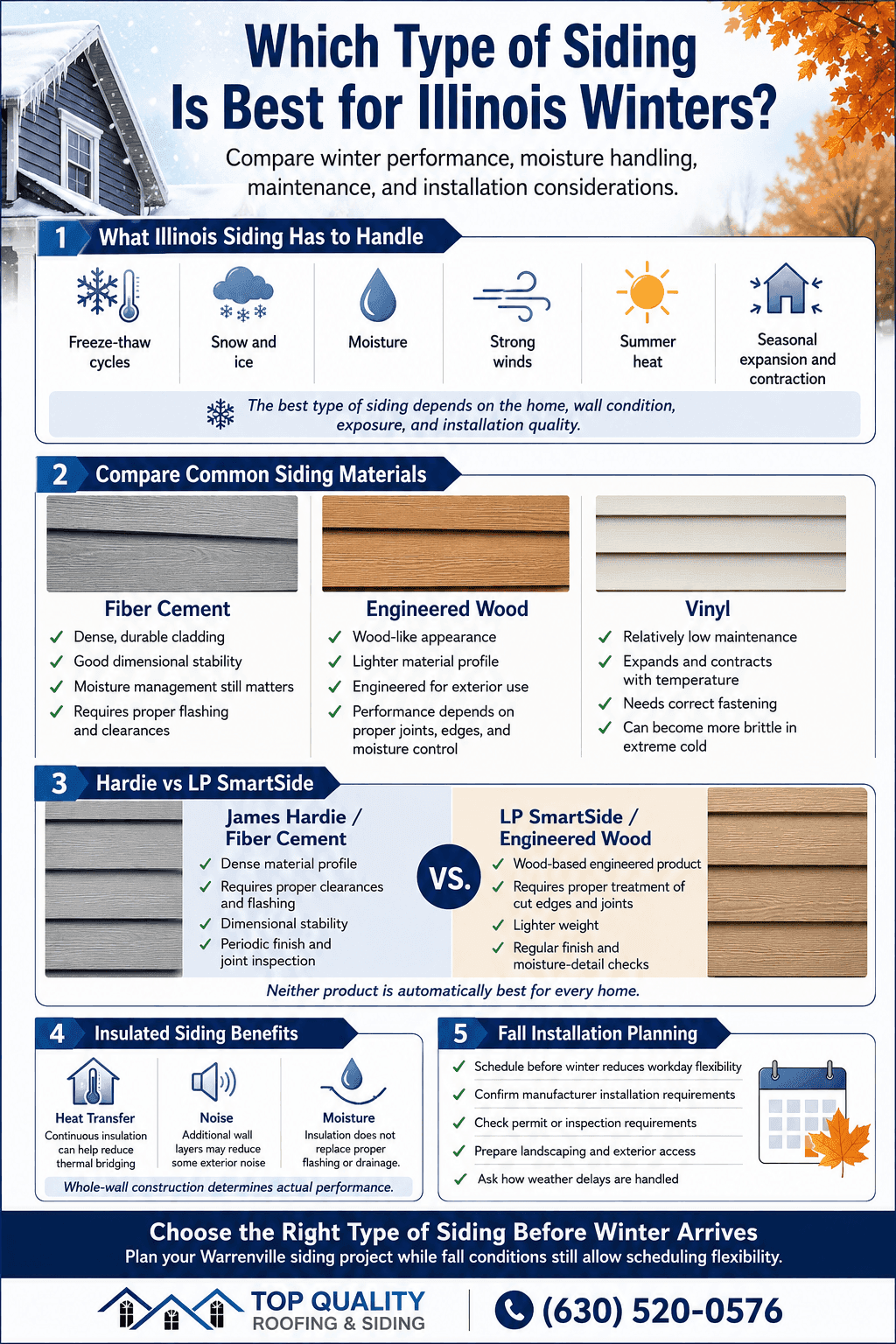
The best type of siding for an Illinois home depends on winter exposure, moisture management, maintenance needs, and installation quality.
Hardie vs LP SmartSide: Winter Performance Comparison
Homeowners researching Hardie vs LP SmartSide are comparing two very different siding materials.
James Hardie siding is fiber cement, while LP SmartSide is an engineered wood product.
Both can be used successfully in cold climates when the wall assembly is properly prepared and the products are installed according to their respective manufacturer requirements.
The best choice depends on more than winter temperature alone.
Moisture Resistance Works Differently
James Hardie fiber cement and LP SmartSide engineered wood manage exterior exposure differently, so each product has its own installation and maintenance requirements.
Fiber cement requires proper clearances, flashing, sealing, and finishing. LP SmartSide likewise relies on correct treatment of joints, cut edges, trim, coatings, and other moisture-sensitive details.
For either product, proper water management behind the siding remains essential.
Expansion and Contraction Differ by Material
Exterior materials move as temperature and moisture conditions change.
Fiber cement is generally dimensionally stable, while engineered wood has different expansion and contraction characteristics because of its wood-based composition.
Installers account for this through proper gaps, fastening methods, joint treatments, and trim details.
These requirements are especially important in Illinois, where siding may experience hot summer sun followed by freezing winter temperatures within the same year.
Long-Term Maintenance Expectations
Maintenance requirements vary by product, finish, exposure, and installation.
Fiber cement may require periodic inspection of caulked joints, paint or finish condition, flashing, and areas exposed to moisture.
Engineered wood also benefits from regular checks of finishes, joints, cut edges, trim, and locations where water could collect.
Homeowners should follow the maintenance guidance for the exact product installed rather than assuming that any siding material is completely maintenance-free.
Which Type of Siding Works Better for an Older Illinois Home?
No single type of siding is automatically best for every older Illinois home. The better choice depends on the condition and construction of the existing exterior.
Before installation, contractors may need to evaluate:
Wall sheathing and signs of trapped moisture
Existing insulation
Window and door flashing
Previous siding layers
Trim and wall condition
Architectural requirements
Fiber cement may appeal to homeowners who prefer a dense, durable cladding system, while engineered wood can provide a different weight, appearance, and installation profile.
The condition of the existing wall assembly should help guide the final choice.
The Benefits of Insulated Siding
Homeowners searching for insulated siding in IL are often trying to reduce winter heat loss.
It is important to distinguish between insulated siding products and exterior insulation that is installed as part of a broader wall assembly.
Both approaches may affect thermal performance.
Added Insulation Can Reduce Heat Transfer
Continuous insulation installed outside the wall sheathing can help reduce thermal bridging through wall framing.
That can improve the overall thermal resistance of the exterior wall assembly.
The actual benefit depends on the insulation type, thickness, existing wall construction, air sealing, and installation quality.
Siding alone should not be presented as a complete solution for high heating bills.
A home with major attic air leakage, poor insulation, failing windows, or HVAC problems may need additional improvements.
Exterior Assemblies May Help Reduce Outside Noise
Adding insulation and other layers during a siding project may reduce some exterior noise, although results vary based on the complete wall construction, windows, air gaps, and insulation materials.
For homes near busy roads or other exposed locations, siding replacement can be an opportunity to evaluate the exterior wall assembly as a whole.
Moisture Protection Depends on the Whole Wall System
Insulation does not automatically prevent moisture intrusion. Effective protection depends on properly installed flashing, weather-resistive barriers, drainage paths, penetrations, and siding clearances.
Particular attention should be given around:
Windows and doors
Utility and exterior vent penetrations
Roof-to-wall transitions
Deck attachments
Trim joints
Even a high-quality siding product can perform poorly when water-management details behind it are incorrect.
Planning Your Fall Siding Installation the Right Way
Good fall siding planning starts before the old siding is removed.
Homeowners comparing siding contractors in Warrenville should also ask about scheduling flexibility, manufacturer requirements, and how weather delays are handled.
Schedule Before Winter Limits Workdays
Fall weather can change quickly in Illinois.
A project scheduled earlier in the season generally allows more flexibility if rain, wind, or cold temperatures interrupt work.
Homeowners should also account for:
Material lead times
Contractor availability
Delivery schedules
Inspection requirements
Unexpected wall repairs
Shorter daylight hours later in the season
Waiting until freezing weather is imminent can reduce scheduling flexibility.
Confirm Permit and Project Requirements
Permit and inspection requirements can vary by municipality and project scope.
A straightforward siding replacement may have different requirements from work involving structural repairs, insulation changes, or wall modifications.
Homeowners should confirm local requirements before installation begins and allow for the possibility that concealed sheathing or moisture damage may require additional work once the old siding is removed.
Prepare Landscaping and Exterior Access
Siding crews need clear access to the exterior walls, so a little preparation can help work move more efficiently.
Before installation, homeowners may need to:
Move patio furniture, grills, and planters
Trim vegetation where necessary
Provide driveway or delivery access
Remove fragile exterior decorations
Keep pets and children away from active work areas
Ask the contractor how landscaping, windows, walkways, and nearby surfaces will be protected during removal and installation.
Choose Siding Based on the Whole Home, Not Just the Material
The right siding for winter in IL depends on the home’s existing wall condition, exposure, maintenance needs, and installation requirements.
Fiber cement, engineered wood, vinyl, and insulated siding systems can all be appropriate for Illinois homes. The better choice comes from matching the material to the structure rather than relying on the product name alone.
For homeowners comparing Hardie vs LP SmartSide, considering insulated siding, or preparing an older exterior for winter, fall can provide a practical installation window before colder weather reduces scheduling flexibility.
Planning a siding project in Warrenville before winter? Call Top Quality Roofing at (630) 520-0576 to schedule a siding consultation, or contact us to request an estimate. |
Choosing siding for winter in IL is about more than curb appeal. The right type of siding can help protect exterior walls from moisture, support the home’s thermal performance, and prepare the building envelope for snow, wind, and repeated freeze-thaw conditions.
For Illinois homeowners planning an exterior update, fall can be a practical time to replace worn or damaged siding before colder weather exposes existing weaknesses.
Why Fall Is a Smart Season for Siding Projects
Fall can provide practical conditions for siding work when temperatures, daylight, and weather remain within manufacturer installation requirements.
Scheduling before colder weather becomes less predictable also gives homeowners more flexibility if rain, wind, material deliveries, or unexpected exterior repairs affect the project timeline.
Moderate Temperatures Can Support Installation Quality
Extreme summer heat and deep winter cold can make exterior work more challenging. Moderate fall temperatures can provide more manageable conditions for handling and installing siding materials.
A siding project also involves more than the visible panels. Housewrap, flashing, trim, fasteners, sealants, insulation, and water-management details all need to be installed according to the requirements of the selected system.
New Siding Adds Protection Before Snow and Ice Arrive
Damaged siding can leave exterior walls more vulnerable to wind-driven moisture.
Cracks, loose panels, missing sections, deteriorated trim, or poorly sealed penetrations may allow water to reach the layers behind the siding.
Winter can make those weaknesses more difficult to address.
Replacing damaged siding in fall gives homeowners an opportunity to correct exterior problems before snow, freezing rain, and repeated temperature swings arrive.
Exterior Improvements Can Support Heating-Season Efficiency
Siding is only one part of a home’s energy performance, but replacement work can provide an opportunity to inspect the exterior wall assembly and address gaps in weather protection.
When appropriate, homeowners may also consider continuous exterior insulation to reduce heat transfer through wall framing. The actual benefit depends on existing insulation, air sealing, windows, doors, and the overall construction of the home.
What Type of Siding Performs Best in Illinois Winters?
The best type of siding for an Illinois home depends on moisture exposure, maintenance expectations, wall condition, and how the material handles seasonal temperature changes.
Fiber cement, engineered wood, and vinyl can all perform successfully in Illinois when the product is suited to the home and installed according to manufacturer requirements.
Fiber Cement and Freeze-Thaw Conditions
Fiber cement is a dense exterior cladding made from cement-based materials and reinforcing fibers. It is commonly selected for its durability and dimensional stability.
Winter performance still depends heavily on moisture management. Proper flashing, clearances, drainage details, and finishing help keep water from reaching vulnerable areas before repeated freezing and thawing occur.
Fiber cement should therefore be treated as part of a complete exterior wall system rather than as a standalone moisture barrier.
Engineered Wood Offers a Different Material Profile
Engineered wood siding uses wood strands or fibers combined with resins and protective treatments. Products such as LP SmartSide are designed to provide a wood-like appearance with engineered consistency and durability.
Engineered wood siding itself should not be confused with insulation. Any thermal-performance benefit depends on the complete wall assembly and whether additional insulation is installed behind the siding.
Its lighter weight compared with some fiber cement products may also affect handling and installation, depending on the project.
Vinyl Siding Requires Proper Cold-Weather Installation
Vinyl siding is widely used because it is relatively low maintenance and available in many colors and profiles.
It also expands and contracts as temperatures change.
Proper installation allows panels to move rather than fastening them so tightly that seasonal movement causes distortion.
During very cold weather, vinyl can become more brittle and may be more vulnerable to impact.
That does not mean vinyl siding cannot perform in Illinois. It means installation details, product quality, and correct fastening become especially important in a climate with significant seasonal temperature changes.
The best type of siding for an Illinois home depends on winter exposure, moisture management, maintenance needs, and installation quality.
Hardie vs LP SmartSide: Winter Performance Comparison
Homeowners researching Hardie vs LP SmartSide are comparing two very different siding materials.
James Hardie siding is fiber cement, while LP SmartSide is an engineered wood product.
Both can be used successfully in cold climates when the wall assembly is properly prepared and the products are installed according to their respective manufacturer requirements.
The best choice depends on more than winter temperature alone.
Moisture Resistance Works Differently
James Hardie fiber cement and LP SmartSide engineered wood manage exterior exposure differently, so each product has its own installation and maintenance requirements.
Fiber cement requires proper clearances, flashing, sealing, and finishing. LP SmartSide likewise relies on correct treatment of joints, cut edges, trim, coatings, and other moisture-sensitive details.
For either product, proper water management behind the siding remains essential.
Expansion and Contraction Differ by Material
Exterior materials move as temperature and moisture conditions change.
Fiber cement is generally dimensionally stable, while engineered wood has different expansion and contraction characteristics because of its wood-based composition.
Installers account for this through proper gaps, fastening methods, joint treatments, and trim details.
These requirements are especially important in Illinois, where siding may experience hot summer sun followed by freezing winter temperatures within the same year.
Long-Term Maintenance Expectations
Maintenance requirements vary by product, finish, exposure, and installation.
Fiber cement may require periodic inspection of caulked joints, paint or finish condition, flashing, and areas exposed to moisture.
Engineered wood also benefits from regular checks of finishes, joints, cut edges, trim, and locations where water could collect.
Homeowners should follow the maintenance guidance for the exact product installed rather than assuming that any siding material is completely maintenance-free.
Which Type of Siding Works Better for an Older Illinois Home?
No single type of siding is automatically best for every older Illinois home. The better choice depends on the condition and construction of the existing exterior.
Before installation, contractors may need to evaluate:
Wall sheathing and signs of trapped moisture
Existing insulation
Window and door flashing
Previous siding layers
Trim and wall condition
Architectural requirements
Fiber cement may appeal to homeowners who prefer a dense, durable cladding system, while engineered wood can provide a different weight, appearance, and installation profile.
The condition of the existing wall assembly should help guide the final choice.
The Benefits of Insulated Siding
Homeowners searching for insulated siding in IL are often trying to reduce winter heat loss.
It is important to distinguish between insulated siding products and exterior insulation that is installed as part of a broader wall assembly.
Both approaches may affect thermal performance.
Added Insulation Can Reduce Heat Transfer
Continuous insulation installed outside the wall sheathing can help reduce thermal bridging through wall framing.
That can improve the overall thermal resistance of the exterior wall assembly.
The actual benefit depends on the insulation type, thickness, existing wall construction, air sealing, and installation quality.
Siding alone should not be presented as a complete solution for high heating bills.
A home with major attic air leakage, poor insulation, failing windows, or HVAC problems may need additional improvements.
Exterior Assemblies May Help Reduce Outside Noise
Adding insulation and other layers during a siding project may reduce some exterior noise, although results vary based on the complete wall construction, windows, air gaps, and insulation materials.
For homes near busy roads or other exposed locations, siding replacement can be an opportunity to evaluate the exterior wall assembly as a whole.
Moisture Protection Depends on the Whole Wall System
Insulation does not automatically prevent moisture intrusion. Effective protection depends on properly installed flashing, weather-resistive barriers, drainage paths, penetrations, and siding clearances.
Particular attention should be given around:
Windows and doors
Utility and exterior vent penetrations
Roof-to-wall transitions
Deck attachments
Trim joints
Even a high-quality siding product can perform poorly when water-management details behind it are incorrect.
Planning Your Fall Siding Installation the Right Way
Good fall siding planning starts before the old siding is removed.
Homeowners comparing siding contractors in Warrenville should also ask about scheduling flexibility, manufacturer requirements, and how weather delays are handled.
Schedule Before Winter Limits Workdays
Fall weather can change quickly in Illinois.
A project scheduled earlier in the season generally allows more flexibility if rain, wind, or cold temperatures interrupt work.
Homeowners should also account for:
Material lead times
Contractor availability
Delivery schedules
Inspection requirements
Unexpected wall repairs
Shorter daylight hours later in the season
Waiting until freezing weather is imminent can reduce scheduling flexibility.
Confirm Permit and Project Requirements
Permit and inspection requirements can vary by municipality and project scope.
A straightforward siding replacement may have different requirements from work involving structural repairs, insulation changes, or wall modifications.
Homeowners should confirm local requirements before installation begins and allow for the possibility that concealed sheathing or moisture damage may require additional work once the old siding is removed.
Prepare Landscaping and Exterior Access
Siding crews need clear access to the exterior walls, so a little preparation can help work move more efficiently.
Before installation, homeowners may need to:
Move patio furniture, grills, and planters
Trim vegetation where necessary
Provide driveway or delivery access
Remove fragile exterior decorations
Keep pets and children away from active work areas
Ask the contractor how landscaping, windows, walkways, and nearby surfaces will be protected during removal and installation.
Choose Siding Based on the Whole Home, Not Just the Material
The right siding for winter in IL depends on the home’s existing wall condition, exposure, maintenance needs, and installation requirements.
Fiber cement, engineered wood, vinyl, and insulated siding systems can all be appropriate for Illinois homes. The better choice comes from matching the material to the structure rather than relying on the product name alone.
For homeowners comparing Hardie vs LP SmartSide, considering insulated siding, or preparing an older exterior for winter, fall can provide a practical installation window before colder weather reduces scheduling flexibility.
Planning a siding project in Warrenville before winter? Call Top Quality Roofing at (630) 520-0576 to schedule a siding consultation, or contact us to request an estimate. |
Choosing siding for winter in IL is about more than curb appeal. The right type of siding can help protect exterior walls from moisture, support the home’s thermal performance, and prepare the building envelope for snow, wind, and repeated freeze-thaw conditions.
For Illinois homeowners planning an exterior update, fall can be a practical time to replace worn or damaged siding before colder weather exposes existing weaknesses.
Why Fall Is a Smart Season for Siding Projects
Fall can provide practical conditions for siding work when temperatures, daylight, and weather remain within manufacturer installation requirements.
Scheduling before colder weather becomes less predictable also gives homeowners more flexibility if rain, wind, material deliveries, or unexpected exterior repairs affect the project timeline.
Moderate Temperatures Can Support Installation Quality
Extreme summer heat and deep winter cold can make exterior work more challenging. Moderate fall temperatures can provide more manageable conditions for handling and installing siding materials.
A siding project also involves more than the visible panels. Housewrap, flashing, trim, fasteners, sealants, insulation, and water-management details all need to be installed according to the requirements of the selected system.
New Siding Adds Protection Before Snow and Ice Arrive
Damaged siding can leave exterior walls more vulnerable to wind-driven moisture.
Cracks, loose panels, missing sections, deteriorated trim, or poorly sealed penetrations may allow water to reach the layers behind the siding.
Winter can make those weaknesses more difficult to address.
Replacing damaged siding in fall gives homeowners an opportunity to correct exterior problems before snow, freezing rain, and repeated temperature swings arrive.
Exterior Improvements Can Support Heating-Season Efficiency
Siding is only one part of a home’s energy performance, but replacement work can provide an opportunity to inspect the exterior wall assembly and address gaps in weather protection.
When appropriate, homeowners may also consider continuous exterior insulation to reduce heat transfer through wall framing. The actual benefit depends on existing insulation, air sealing, windows, doors, and the overall construction of the home.
What Type of Siding Performs Best in Illinois Winters?
The best type of siding for an Illinois home depends on moisture exposure, maintenance expectations, wall condition, and how the material handles seasonal temperature changes.
Fiber cement, engineered wood, and vinyl can all perform successfully in Illinois when the product is suited to the home and installed according to manufacturer requirements.
Fiber Cement and Freeze-Thaw Conditions
Fiber cement is a dense exterior cladding made from cement-based materials and reinforcing fibers. It is commonly selected for its durability and dimensional stability.
Winter performance still depends heavily on moisture management. Proper flashing, clearances, drainage details, and finishing help keep water from reaching vulnerable areas before repeated freezing and thawing occur.
Fiber cement should therefore be treated as part of a complete exterior wall system rather than as a standalone moisture barrier.
Engineered Wood Offers a Different Material Profile
Engineered wood siding uses wood strands or fibers combined with resins and protective treatments. Products such as LP SmartSide are designed to provide a wood-like appearance with engineered consistency and durability.
Engineered wood siding itself should not be confused with insulation. Any thermal-performance benefit depends on the complete wall assembly and whether additional insulation is installed behind the siding.
Its lighter weight compared with some fiber cement products may also affect handling and installation, depending on the project.
Vinyl Siding Requires Proper Cold-Weather Installation
Vinyl siding is widely used because it is relatively low maintenance and available in many colors and profiles.
It also expands and contracts as temperatures change.
Proper installation allows panels to move rather than fastening them so tightly that seasonal movement causes distortion.
During very cold weather, vinyl can become more brittle and may be more vulnerable to impact.
That does not mean vinyl siding cannot perform in Illinois. It means installation details, product quality, and correct fastening become especially important in a climate with significant seasonal temperature changes.
The best type of siding for an Illinois home depends on winter exposure, moisture management, maintenance needs, and installation quality.
Hardie vs LP SmartSide: Winter Performance Comparison
Homeowners researching Hardie vs LP SmartSide are comparing two very different siding materials.
James Hardie siding is fiber cement, while LP SmartSide is an engineered wood product.
Both can be used successfully in cold climates when the wall assembly is properly prepared and the products are installed according to their respective manufacturer requirements.
The best choice depends on more than winter temperature alone.
Moisture Resistance Works Differently
James Hardie fiber cement and LP SmartSide engineered wood manage exterior exposure differently, so each product has its own installation and maintenance requirements.
Fiber cement requires proper clearances, flashing, sealing, and finishing. LP SmartSide likewise relies on correct treatment of joints, cut edges, trim, coatings, and other moisture-sensitive details.
For either product, proper water management behind the siding remains essential.
Expansion and Contraction Differ by Material
Exterior materials move as temperature and moisture conditions change.
Fiber cement is generally dimensionally stable, while engineered wood has different expansion and contraction characteristics because of its wood-based composition.
Installers account for this through proper gaps, fastening methods, joint treatments, and trim details.
These requirements are especially important in Illinois, where siding may experience hot summer sun followed by freezing winter temperatures within the same year.
Long-Term Maintenance Expectations
Maintenance requirements vary by product, finish, exposure, and installation.
Fiber cement may require periodic inspection of caulked joints, paint or finish condition, flashing, and areas exposed to moisture.
Engineered wood also benefits from regular checks of finishes, joints, cut edges, trim, and locations where water could collect.
Homeowners should follow the maintenance guidance for the exact product installed rather than assuming that any siding material is completely maintenance-free.
Which Type of Siding Works Better for an Older Illinois Home?
No single type of siding is automatically best for every older Illinois home. The better choice depends on the condition and construction of the existing exterior.
Before installation, contractors may need to evaluate:
Wall sheathing and signs of trapped moisture
Existing insulation
Window and door flashing
Previous siding layers
Trim and wall condition
Architectural requirements
Fiber cement may appeal to homeowners who prefer a dense, durable cladding system, while engineered wood can provide a different weight, appearance, and installation profile.
The condition of the existing wall assembly should help guide the final choice.
The Benefits of Insulated Siding
Homeowners searching for insulated siding in IL are often trying to reduce winter heat loss.
It is important to distinguish between insulated siding products and exterior insulation that is installed as part of a broader wall assembly.
Both approaches may affect thermal performance.
Added Insulation Can Reduce Heat Transfer
Continuous insulation installed outside the wall sheathing can help reduce thermal bridging through wall framing.
That can improve the overall thermal resistance of the exterior wall assembly.
The actual benefit depends on the insulation type, thickness, existing wall construction, air sealing, and installation quality.
Siding alone should not be presented as a complete solution for high heating bills.
A home with major attic air leakage, poor insulation, failing windows, or HVAC problems may need additional improvements.
Exterior Assemblies May Help Reduce Outside Noise
Adding insulation and other layers during a siding project may reduce some exterior noise, although results vary based on the complete wall construction, windows, air gaps, and insulation materials.
For homes near busy roads or other exposed locations, siding replacement can be an opportunity to evaluate the exterior wall assembly as a whole.
Moisture Protection Depends on the Whole Wall System
Insulation does not automatically prevent moisture intrusion. Effective protection depends on properly installed flashing, weather-resistive barriers, drainage paths, penetrations, and siding clearances.
Particular attention should be given around:
Windows and doors
Utility and exterior vent penetrations
Roof-to-wall transitions
Deck attachments
Trim joints
Even a high-quality siding product can perform poorly when water-management details behind it are incorrect.
Planning Your Fall Siding Installation the Right Way
Good fall siding planning starts before the old siding is removed.
Homeowners comparing siding contractors in Warrenville should also ask about scheduling flexibility, manufacturer requirements, and how weather delays are handled.
Schedule Before Winter Limits Workdays
Fall weather can change quickly in Illinois.
A project scheduled earlier in the season generally allows more flexibility if rain, wind, or cold temperatures interrupt work.
Homeowners should also account for:
Material lead times
Contractor availability
Delivery schedules
Inspection requirements
Unexpected wall repairs
Shorter daylight hours later in the season
Waiting until freezing weather is imminent can reduce scheduling flexibility.
Confirm Permit and Project Requirements
Permit and inspection requirements can vary by municipality and project scope.
A straightforward siding replacement may have different requirements from work involving structural repairs, insulation changes, or wall modifications.
Homeowners should confirm local requirements before installation begins and allow for the possibility that concealed sheathing or moisture damage may require additional work once the old siding is removed.
Prepare Landscaping and Exterior Access
Siding crews need clear access to the exterior walls, so a little preparation can help work move more efficiently.
Before installation, homeowners may need to:
Move patio furniture, grills, and planters
Trim vegetation where necessary
Provide driveway or delivery access
Remove fragile exterior decorations
Keep pets and children away from active work areas
Ask the contractor how landscaping, windows, walkways, and nearby surfaces will be protected during removal and installation.
Choose Siding Based on the Whole Home, Not Just the Material
The right siding for winter in IL depends on the home’s existing wall condition, exposure, maintenance needs, and installation requirements.
Fiber cement, engineered wood, vinyl, and insulated siding systems can all be appropriate for Illinois homes. The better choice comes from matching the material to the structure rather than relying on the product name alone.
For homeowners comparing Hardie vs LP SmartSide, considering insulated siding, or preparing an older exterior for winter, fall can provide a practical installation window before colder weather reduces scheduling flexibility.
Planning a siding project in Warrenville before winter? Call Top Quality Roofing at (630) 520-0576 to schedule a siding consultation, or contact us to request an estimate. |
Choosing siding for winter in IL is about more than curb appeal. The right type of siding can help protect exterior walls from moisture, support the home’s thermal performance, and prepare the building envelope for snow, wind, and repeated freeze-thaw conditions.
For Illinois homeowners planning an exterior update, fall can be a practical time to replace worn or damaged siding before colder weather exposes existing weaknesses.
Why Fall Is a Smart Season for Siding Projects
Fall can provide practical conditions for siding work when temperatures, daylight, and weather remain within manufacturer installation requirements.
Scheduling before colder weather becomes less predictable also gives homeowners more flexibility if rain, wind, material deliveries, or unexpected exterior repairs affect the project timeline.
Moderate Temperatures Can Support Installation Quality
Extreme summer heat and deep winter cold can make exterior work more challenging. Moderate fall temperatures can provide more manageable conditions for handling and installing siding materials.
A siding project also involves more than the visible panels. Housewrap, flashing, trim, fasteners, sealants, insulation, and water-management details all need to be installed according to the requirements of the selected system.
New Siding Adds Protection Before Snow and Ice Arrive
Damaged siding can leave exterior walls more vulnerable to wind-driven moisture.
Cracks, loose panels, missing sections, deteriorated trim, or poorly sealed penetrations may allow water to reach the layers behind the siding.
Winter can make those weaknesses more difficult to address.
Replacing damaged siding in fall gives homeowners an opportunity to correct exterior problems before snow, freezing rain, and repeated temperature swings arrive.
Exterior Improvements Can Support Heating-Season Efficiency
Siding is only one part of a home’s energy performance, but replacement work can provide an opportunity to inspect the exterior wall assembly and address gaps in weather protection.
When appropriate, homeowners may also consider continuous exterior insulation to reduce heat transfer through wall framing. The actual benefit depends on existing insulation, air sealing, windows, doors, and the overall construction of the home.
What Type of Siding Performs Best in Illinois Winters?
The best type of siding for an Illinois home depends on moisture exposure, maintenance expectations, wall condition, and how the material handles seasonal temperature changes.
Fiber cement, engineered wood, and vinyl can all perform successfully in Illinois when the product is suited to the home and installed according to manufacturer requirements.
Fiber Cement and Freeze-Thaw Conditions
Fiber cement is a dense exterior cladding made from cement-based materials and reinforcing fibers. It is commonly selected for its durability and dimensional stability.
Winter performance still depends heavily on moisture management. Proper flashing, clearances, drainage details, and finishing help keep water from reaching vulnerable areas before repeated freezing and thawing occur.
Fiber cement should therefore be treated as part of a complete exterior wall system rather than as a standalone moisture barrier.
Engineered Wood Offers a Different Material Profile
Engineered wood siding uses wood strands or fibers combined with resins and protective treatments. Products such as LP SmartSide are designed to provide a wood-like appearance with engineered consistency and durability.
Engineered wood siding itself should not be confused with insulation. Any thermal-performance benefit depends on the complete wall assembly and whether additional insulation is installed behind the siding.
Its lighter weight compared with some fiber cement products may also affect handling and installation, depending on the project.
Vinyl Siding Requires Proper Cold-Weather Installation
Vinyl siding is widely used because it is relatively low maintenance and available in many colors and profiles.
It also expands and contracts as temperatures change.
Proper installation allows panels to move rather than fastening them so tightly that seasonal movement causes distortion.
During very cold weather, vinyl can become more brittle and may be more vulnerable to impact.
That does not mean vinyl siding cannot perform in Illinois. It means installation details, product quality, and correct fastening become especially important in a climate with significant seasonal temperature changes.
The best type of siding for an Illinois home depends on winter exposure, moisture management, maintenance needs, and installation quality.
Hardie vs LP SmartSide: Winter Performance Comparison
Homeowners researching Hardie vs LP SmartSide are comparing two very different siding materials.
James Hardie siding is fiber cement, while LP SmartSide is an engineered wood product.
Both can be used successfully in cold climates when the wall assembly is properly prepared and the products are installed according to their respective manufacturer requirements.
The best choice depends on more than winter temperature alone.
Moisture Resistance Works Differently
James Hardie fiber cement and LP SmartSide engineered wood manage exterior exposure differently, so each product has its own installation and maintenance requirements.
Fiber cement requires proper clearances, flashing, sealing, and finishing. LP SmartSide likewise relies on correct treatment of joints, cut edges, trim, coatings, and other moisture-sensitive details.
For either product, proper water management behind the siding remains essential.
Expansion and Contraction Differ by Material
Exterior materials move as temperature and moisture conditions change.
Fiber cement is generally dimensionally stable, while engineered wood has different expansion and contraction characteristics because of its wood-based composition.
Installers account for this through proper gaps, fastening methods, joint treatments, and trim details.
These requirements are especially important in Illinois, where siding may experience hot summer sun followed by freezing winter temperatures within the same year.
Long-Term Maintenance Expectations
Maintenance requirements vary by product, finish, exposure, and installation.
Fiber cement may require periodic inspection of caulked joints, paint or finish condition, flashing, and areas exposed to moisture.
Engineered wood also benefits from regular checks of finishes, joints, cut edges, trim, and locations where water could collect.
Homeowners should follow the maintenance guidance for the exact product installed rather than assuming that any siding material is completely maintenance-free.
Which Type of Siding Works Better for an Older Illinois Home?
No single type of siding is automatically best for every older Illinois home. The better choice depends on the condition and construction of the existing exterior.
Before installation, contractors may need to evaluate:
Wall sheathing and signs of trapped moisture
Existing insulation
Window and door flashing
Previous siding layers
Trim and wall condition
Architectural requirements
Fiber cement may appeal to homeowners who prefer a dense, durable cladding system, while engineered wood can provide a different weight, appearance, and installation profile.
The condition of the existing wall assembly should help guide the final choice.
The Benefits of Insulated Siding
Homeowners searching for insulated siding in IL are often trying to reduce winter heat loss.
It is important to distinguish between insulated siding products and exterior insulation that is installed as part of a broader wall assembly.
Both approaches may affect thermal performance.
Added Insulation Can Reduce Heat Transfer
Continuous insulation installed outside the wall sheathing can help reduce thermal bridging through wall framing.
That can improve the overall thermal resistance of the exterior wall assembly.
The actual benefit depends on the insulation type, thickness, existing wall construction, air sealing, and installation quality.
Siding alone should not be presented as a complete solution for high heating bills.
A home with major attic air leakage, poor insulation, failing windows, or HVAC problems may need additional improvements.
Exterior Assemblies May Help Reduce Outside Noise
Adding insulation and other layers during a siding project may reduce some exterior noise, although results vary based on the complete wall construction, windows, air gaps, and insulation materials.
For homes near busy roads or other exposed locations, siding replacement can be an opportunity to evaluate the exterior wall assembly as a whole.
Moisture Protection Depends on the Whole Wall System
Insulation does not automatically prevent moisture intrusion. Effective protection depends on properly installed flashing, weather-resistive barriers, drainage paths, penetrations, and siding clearances.
Particular attention should be given around:
Windows and doors
Utility and exterior vent penetrations
Roof-to-wall transitions
Deck attachments
Trim joints
Even a high-quality siding product can perform poorly when water-management details behind it are incorrect.
Planning Your Fall Siding Installation the Right Way
Good fall siding planning starts before the old siding is removed.
Homeowners comparing siding contractors in Warrenville should also ask about scheduling flexibility, manufacturer requirements, and how weather delays are handled.
Schedule Before Winter Limits Workdays
Fall weather can change quickly in Illinois.
A project scheduled earlier in the season generally allows more flexibility if rain, wind, or cold temperatures interrupt work.
Homeowners should also account for:
Material lead times
Contractor availability
Delivery schedules
Inspection requirements
Unexpected wall repairs
Shorter daylight hours later in the season
Waiting until freezing weather is imminent can reduce scheduling flexibility.
Confirm Permit and Project Requirements
Permit and inspection requirements can vary by municipality and project scope.
A straightforward siding replacement may have different requirements from work involving structural repairs, insulation changes, or wall modifications.
Homeowners should confirm local requirements before installation begins and allow for the possibility that concealed sheathing or moisture damage may require additional work once the old siding is removed.
Prepare Landscaping and Exterior Access
Siding crews need clear access to the exterior walls, so a little preparation can help work move more efficiently.
Before installation, homeowners may need to:
Move patio furniture, grills, and planters
Trim vegetation where necessary
Provide driveway or delivery access
Remove fragile exterior decorations
Keep pets and children away from active work areas
Ask the contractor how landscaping, windows, walkways, and nearby surfaces will be protected during removal and installation.
Choose Siding Based on the Whole Home, Not Just the Material
The right siding for winter in IL depends on the home’s existing wall condition, exposure, maintenance needs, and installation requirements.
Fiber cement, engineered wood, vinyl, and insulated siding systems can all be appropriate for Illinois homes. The better choice comes from matching the material to the structure rather than relying on the product name alone.
For homeowners comparing Hardie vs LP SmartSide, considering insulated siding, or preparing an older exterior for winter, fall can provide a practical installation window before colder weather reduces scheduling flexibility.
Planning a siding project in Warrenville before winter? Call Top Quality Roofing at (630) 520-0576 to schedule a siding consultation, or contact us to request an estimate. |


Pricing & financing



Copyright © 2025 Top Quality Roofing and Siding
Pricing & financing
Copyright © 2025 Top Quality Roofing and Siding
Pricing & financing

Copyright © 2025 Top Quality Roofing and Siding